The Timber Merkle Tree is an optimized variation of a Merkle tree designed to reduce on-chain storage while retaining verifiable integrity. It stores selected data on-chain and emits the remaining data as events for off-chain indexing.
This balances security and scalability: the chain keeps the data needed to commit to the tree, while an off-chain store can retain the nodes needed to construct proofs.
What Is a Timber Merkle Tree?
A normal Merkle tree represents a collection of data as a single root hash. Each leaf is a hash of data, and every internal node is computed by hashing its two child nodes.
In a Timber Merkle Tree, not every node is persisted in contract storage. Nodes outside the on-chain frontier can be emitted as events and indexed off-chain, while the frontier and Merkle root remain on-chain.
Key Components
Leaf nodes
Leaves are hashes of the underlying data, such as transactions. In the diagram below, L1, L3, and L4 are emitted as events for off-chain storage, while L2 is retained on-chain as part of the frontier.
Internal nodes
An internal node is calculated by concatenating and hashing two child nodes:
Hash(1-2) = Hash(L1 || L2)
Only the internal nodes on the frontier need to be stored in the contract. In this example, the left branch is retained on-chain while the Hash(3-4) branch is emitted for off-chain indexing.
Frontier
The frontier is the set of nodes the contract stores so it can efficiently update the tree as new leaves are added. Keeping this compact set on-chain reduces storage costs compared with persisting every leaf and every intermediate hash.
Merkle root
The Merkle root is stored on-chain and commits to the full tree. It is the cryptographic anchor that lets a verifier check whether off-chain data belongs to the committed structure.
Structure
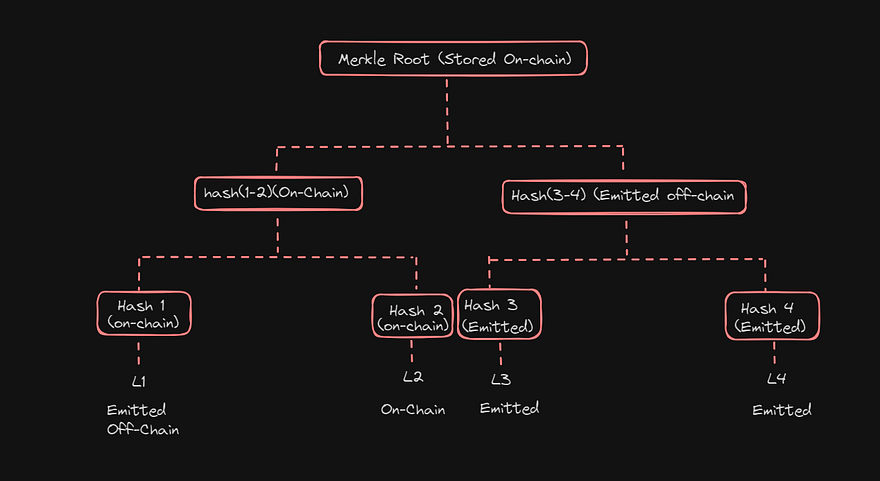
In this example:
L1,L3,L4,Hash(3-4), and its underlying off-frontier nodes are emitted and indexed off-chain.L2, the relevant on-chain hashes, and the Merkle root are retained by the contract.- The on-chain root continues to commit to both the on-chain and off-chain branches.
Proving That a Leaf Belongs to the Tree
A Merkle proof lets someone prove that a leaf belongs to a known Merkle tree without revealing the entire dataset.
Assume we want to prove that L3 is part of the tree.
1. Collect proof components
The verifier needs:
- The hash of
L3. - The sibling hash
L4. - The sibling subtree hash
Hash(1-2)from the on-chain frontier. - The on-chain Merkle root to compare against the reconstructed result.
2. Retrieve off-chain data
L3, L4, and Hash(3-4) are available from the events emitted when those nodes were added. An indexer or database such as MongoDB can retrieve this data.
3. Reconstruct the branch
First compute the right-side internal node:
Hash(3-4) = Hash(L3 || L4)
Then combine it with the on-chain sibling subtree:
Merkle Root = Hash(Hash(1-2) || Hash(3-4))
4. Verify the root
Compare the reconstructed root with the root stored by the contract. If they match, L3 belongs to the tree committed on-chain.
The left/right ordering of each sibling is part of the proof: changing the order changes the hash and should cause verification to fail.
Why Use This Design?
Gas efficiency
Storing only the frontier and root on-chain reduces storage writes and therefore gas costs.
Scalability
As the tree grows, the contract updates a limited on-chain state while off-chain services index emitted nodes. This is useful when the application needs to manage a large number of leaves.
Verifiable off-chain data
Even though many nodes live off-chain, they remain accountable to the root stored on-chain. A valid proof must still reconstruct that root.
Conclusion
The Timber Merkle Tree is a practical pattern for applications that need both efficient on-chain state and verifiable off-chain data. By retaining the Merkle root and a compact frontier in the contract, while emitting the rest of the structure as events, it can lower storage costs without giving up cryptographic verification.